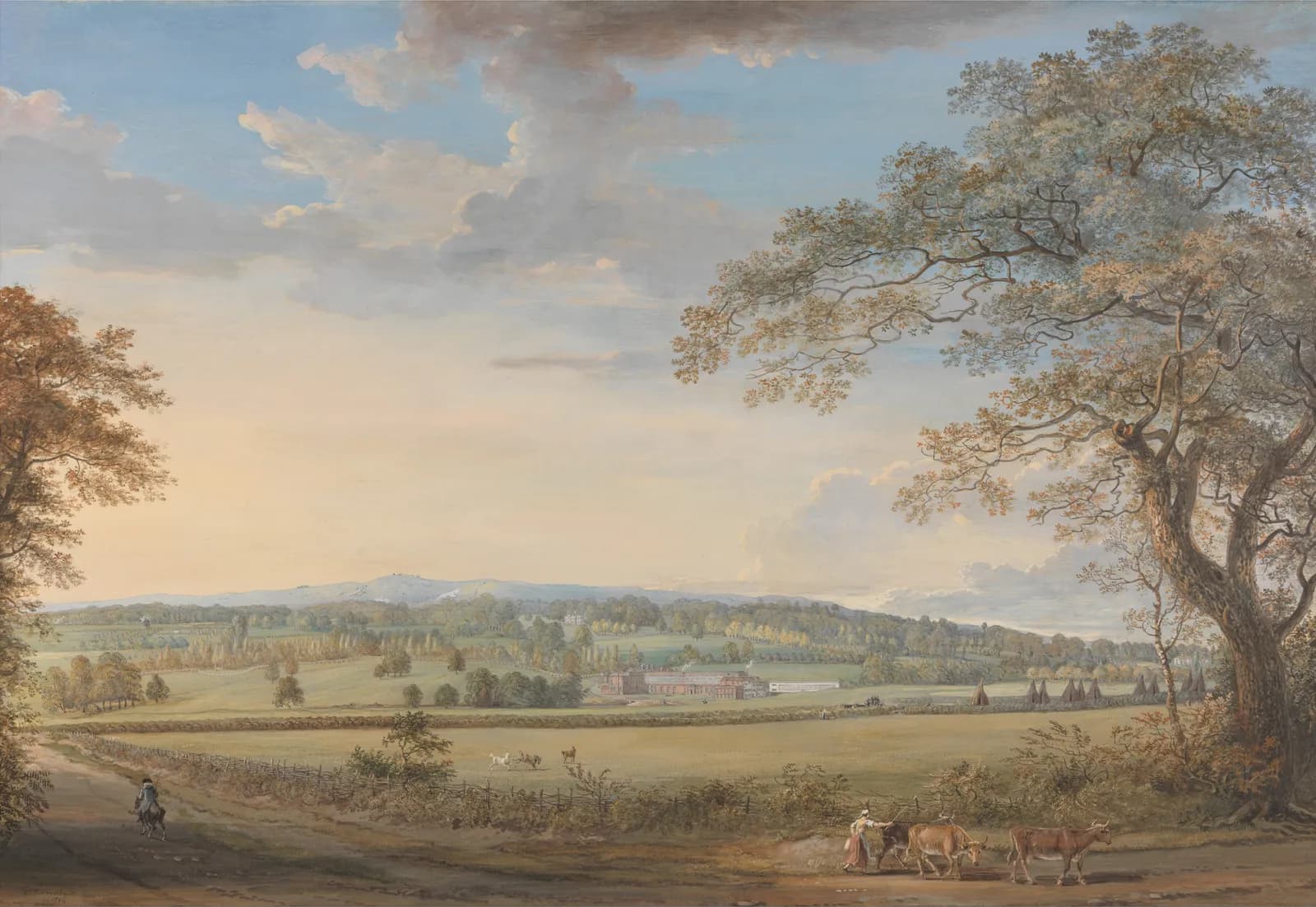
Two centuries before Maidstone became known for modern commerce, a father and son on the banks of the River Len were inventing the technique that would ultimately produce more than 99 per cent of the world's paper.
The Birth of Wove Paper at Turkey Mill
In 1740, James Whatman the Elder and his son achieved something that would transform global communication forever. Working at Turkey Mill in Boxley, on the outskirts of Maidstone, the pair developed wove paper; a smooth, uniform writing surface created using a wooden mould lined with finely-woven brass wire cloth. Before this breakthrough, European papermakers could only produce laid paper, which bore the textured pattern of chain and laid lines from its wire mesh mould. Whatman's wove paper eliminated these impressions entirely.
The timing was fortuitous. Around 1757, printer John Baskerville approached Whatman seeking paper that could take a light impression of the printing plate for his edition of Virgil's poetry. Whatman delivered. The resulting volume, printed on wove paper and featuring Baskerville's newly invented typeface, demonstrated the superior quality of the Maidstone-made product. Benjamin Franklin encountered Whatman paper through this publication and subsequently introduced the technique to the American colonies in 1762, using it to print colonial currency in Philadelphia as early as 1764. He later brought the method to France in 1777.
From Tanner to Papermaking Pioneer
James Whatman the Elder (1702–1759) came to paper making by circumstance rather than design. Born in Kent as the only son of a tanner, he inherited his father's tanning business in 1726 following his mother's death. His entry into papermaking began in 1733 when he assisted James Harris in establishing a new paper mill at the Old Mill in Hollingbourne. When Harris died in 1739, Whatman married his widow, Ann, and acquired the business. Through this marriage, he also gained Turkey Mill, which became the centre of his operations.
Under Whatman's management, Turkey Mill grew to become the largest paper mill in the country. The earliest examples of wove paper bearing his watermark appeared after 1740, establishing the Whatman name as a mark of quality that would endure for more than 260 years.
The Second Generation
James Whatman the Younger (1741–1798) inherited the business upon his father's death in 1759, continuing to refine the techniques pioneered at Turkey Mill. He occupied Turkey Mill until 1775, then expanded operations by purchasing Poll Mill in June 1785. This acquisition allowed him to work in conjunction with Turkey Mill, increasing production capacity. In 1792, he sold Turkey Mill to Thomas, Robert, and Finch Hollingworth for £32,000; a substantial sum that reflected the mill's commercial success.
The Whatman name became synonymous with premium paper sought by artists and institutions alike. Thomas Gainsborough used Turkey Mill paper for his drawings and wrote in 1797 that it was worth "a guinea a quire." J.M.W. Turner and William Blake also favoured Whatman paper; Blake used it for four of his illustrated books.
A Legacy Written in History
The influence of Maidstone's paper making dynasty extended far beyond the art world. Queen Victoria used Whatman paper for her personal correspondence. Napoleon wrote his will on it. The House of Commons stocked Turkey Mill notepaper in its library. In the 1930s, Soviet leaders used Whatman paper to publish their five-year plan. The 1945 peace treaty with Japan was written on Whatman paper. The company's influence was so pervasive that the name entered everyday vocabulary in multiple languages; "le whatman" in French and "vatman" (ватман) in Russian became generic terms for heavy, high-quality drawing paper.
Turkey Mill itself operated for more than 280 years, closing in 1976 as the longest continuously operating paper mill in Great Britain. The Whatman company continued until 2014, when production ceased at Springfield Mill in Maidstone. The brand survives today as part of Cytiva, specialising in laboratory filtration products.
The Whatman Name Today
Maidstone has not forgotten its papermaking heritage. Whatman Park, an 18-acre riverside space approximately half a mile from the town centre, opened in 2001 as part of the Millennium celebrations. Named after the nearby Springfield Mill where the Whatman factory once stood, the park features children's playgrounds, a skate park, boardwalks along the River Medway, and an open-air stage. It hosts the annual Maidstone Mela world arts festival and open-air cinema events.
The Whatman legacy thus endures not merely in museum collections or historical records, but in the very substance of modern paper itself. Every sheet of printing paper, every notebook, every newspaper owes something to the innovation that began on the banks of the River Len in 1740.